How AI Is Transforming the Future of eCommerce
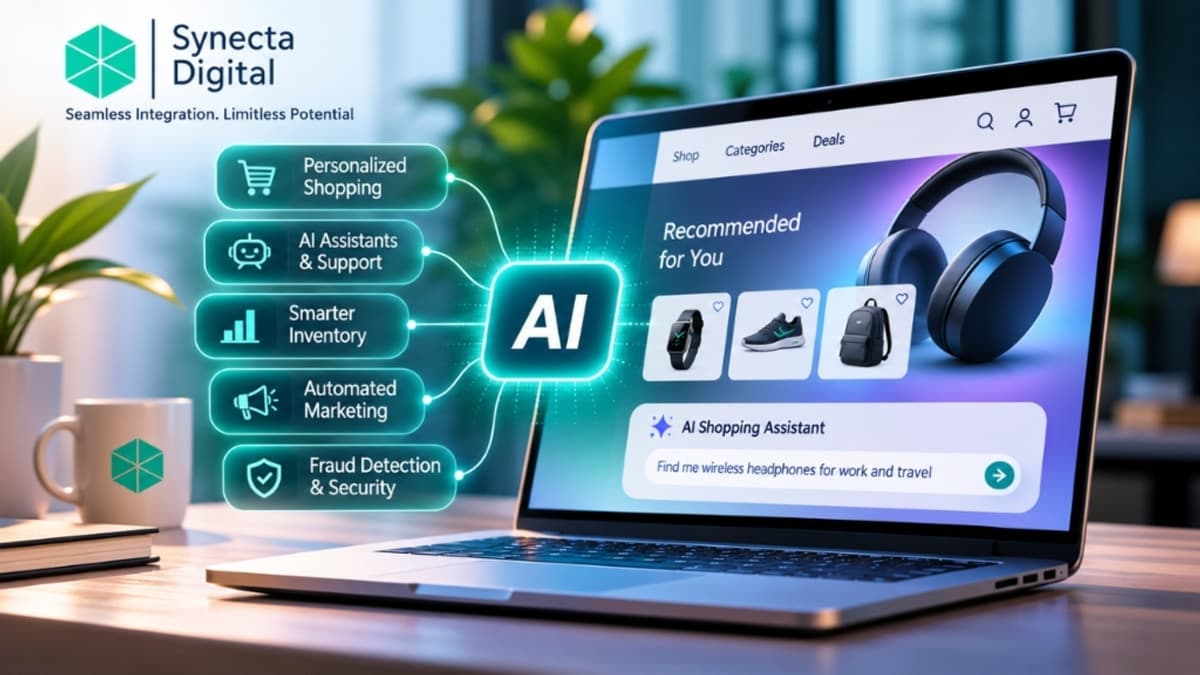
The Evolution of eCommerce: For more than two decades, most online stores operated as static digital product catalogs. Merchants uploaded photographs, wrote descriptions, organized categories, and waited for shoppers to browse pages, type exact keywords into a search bar, and complete checkout. While that model brought retail online, it placed the work of product discovery and comparison entirely on the customer.
Today, eCommerce is evolving toward intelligent, automated, and personalized digital shopping experiences. AI in eCommerce is changing both customer expectations and day-to-day business operations. Shoppers in the United States, the United Kingdom, Europe, Sri Lanka, and across global markets increasingly expect instant answers to product questions, search bars that understand natural language, and relevant recommendations tailored to their needs. Behind the scenes, online retailers use artificial intelligence to forecast inventory demand, detect payment fraud in milliseconds, streamline marketing, and unify online stores with physical retail and ERP workflows.
This guide explores how artificial intelligence in eCommerce works in practice today, how emerging agentic commerce is developing, the risks businesses must manage, and how merchants can prepare.
- •What Is AI in eCommerce?
- •AI-Powered Product Recommendations
- •AI Chatbots and Virtual Shopping Assistants
- •AI-Powered Search and Product Discovery
- •Predictive Analytics and Smarter Inventory Management
- •AI in eCommerce Marketing and Content Creation
- •AI in Payment Security and Fraud Detection
- •Agentic Commerce — The Next Evolution of Online Shopping
- •Challenges and Risks of AI Adoption
- •How Businesses Can Prepare for AI-Driven Commerce
- •The Future of AI in eCommerce
- •Frequently Asked Questions
- •Conclusion
What Is AI in eCommerce?
In online retail, artificial intelligence in eCommerce refers to software systems that analyze store data, recognize patterns, interpret human language or images, and generate context-aware recommendations or decisions without requiring staff to program every rule manually.
Rather than being a single tool, AI-powered eCommerce combines six core technologies that integrate with platforms like Shopify, WooCommerce, and custom headless storefronts:
Machine Learning (ML)
Algorithms that identify patterns in historical orders, browsing behavior, and return rates to improve predictions over time—powering "frequently bought together" bundles and checkout fraud scoring.
Generative AI
Models that create new text, images, or conversational responses from structured prompts and catalog data, helping merchants draft product descriptions, summarize customer reviews, and run interactive buying guides.
Predictive Analytics
Statistical models that analyze historical sales velocity, seasonality, and supplier lead times to forecast product demand, prevent stockouts, and estimate customer lifetime value.
Natural Language Processing (NLP)
Technology that enables software to understand everyday human phrasing and intent—allowing a search bar or chat assistant to interpret "a gentle cleanser for dry sensitive skin" even when those exact words are not in a product title.
Computer Vision
AI that interprets visual details from photos and videos, allowing shoppers to upload a picture of a shoe or handbag to find visually similar items in a store's catalog.
AI Agents
Autonomous or semi-autonomous software systems capable of reasoning through multi-step tasks, querying live inventory, comparing technical specifications, and assisting with support or purchasing workflows.
Implemented thoughtfully through AI for eCommerce solutions, these technologies reduce friction for shoppers while freeing retail teams from repetitive manual administration.
AI-Powered Product Recommendations
Showing the exact same "Featured Products" grid to every visitor misses valuable conversion opportunities. AI product recommendations replace static merchandising with dynamic suggestions that adapt in real time to each customer's behavior, preferences, and shopping context.
Modern recommendation engines evaluate browsing history, time spent on specification tables, items added to the cart, past purchases, and the buying patterns of similar shoppers:
Personalized Product Discovery
Tailoring homepage collections and "recommended for you" carousels around a visitor's preferred categories, sizes, or brands.
Context-Aware Cross-Selling
Suggesting complementary items on product pages or inside slide-out cart drawers—such as pairing a mirrorless camera with a compatible memory card and lens filter.
Intelligent Upselling
Highlighting higher-tier models or value bundles when a shopper compares specifications before checkout.
Replenishment Reminders
Prompting timely repeat orders when consumable items are likely running low based on typical usage cycles.
How Contextual Recommendations Increase Average Order Value
In beauty and skincare retail, when a shopper views a niacinamide serum for oily, blemish-prone skin, a static store might display bestselling heavy facial oils unsuitable for that customer. An AI recommendation engine recognizes the skincare regimen context and suggests a compatible oil-free gel moisturizer and mineral sunscreen—creating a personalized shopping experience that builds customer confidence and increases average order value.

AI Chatbots and Virtual Shopping Assistants
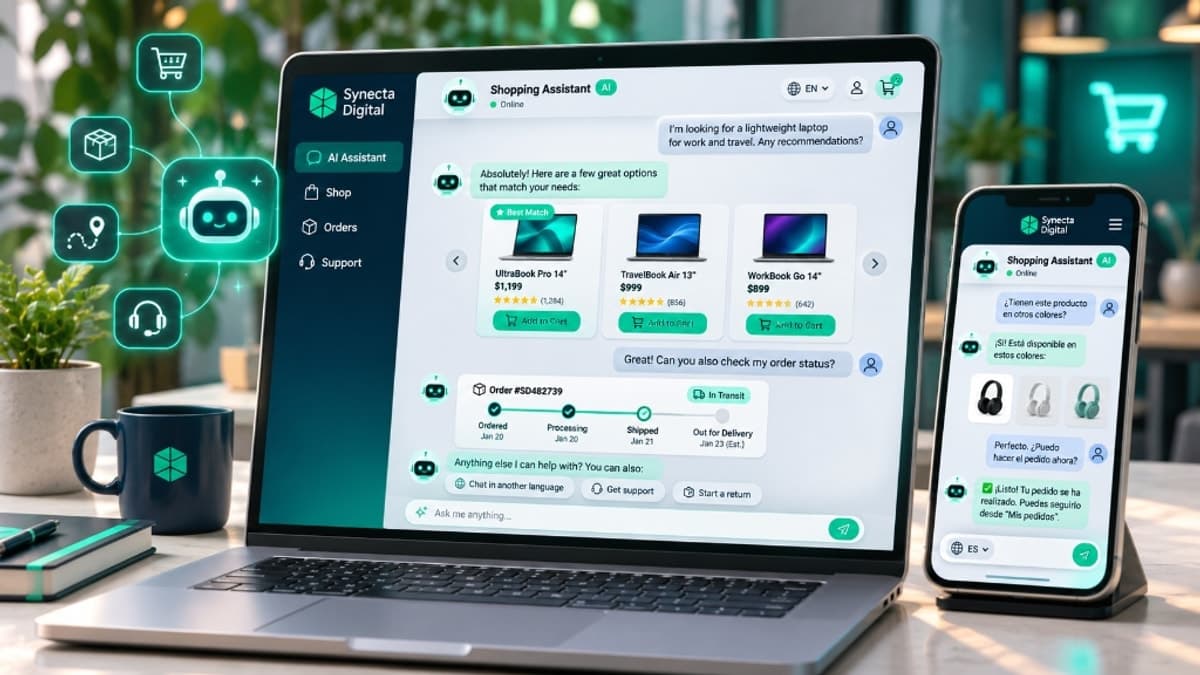
Shoppers often abandon carts because an urgent question goes unanswered at checkout: Will this part fit my device? What is the international return window? AI shopping assistants combine 24/7 availability with live access to a merchant's product catalog, store policies, and order tracking system.
Unlike early rule-based chatbots that trapped users in rigid button menus, modern virtual assistants understand natural conversation and store context.
| Capability | Modern AI Shopping Assistants | Traditional Rule-Based Chatbots |
|---|---|---|
| Conversation Style | Natural multi-turn dialogue that understands context and follow-up questions | Rigid button menus and scripted keyword triggers |
| Product Knowledge | Synced with live Shopify or WooCommerce catalog specs, variants, and stock | Limited to static pre-written FAQ answers |
| Shopping Guidance | Recommends products by use case, compares specs, and guides sizing | Cannot evaluate or compare individual SKU attributes |
| Multilingual Support | Assists international shoppers fluently across dozens of languages | Requires manual translation of every script branch |
| Human Escalation | Hands over complex tickets to human staff with a conversation summary | Frequently loops unhelpful replies when off-script |
For brands serving international time zones—such as a Sri Lankan or European merchant selling to customers in the US and UK—an AI assistant delivers instant 24/7 customer assistance, automates order tracking inquiries, provides multilingual support, and escalates sensitive issues to human agents.
AI-Powered Search and Product Discovery
Visitors who use an on-site search bar have strong purchase intent, yet traditional keyword search fails whenever a buyer's phrasing differs from exact product titles. AI upgrades product discovery through semantic search, natural-language search, and visual product search:
- Semantic intent matching: Recognizes synonyms, conceptual relationships, and spelling variations (understanding that "trainers," "sneakers," and "running shoes" match the same category).
- Conversational natural-language queries: Extracts occasion, budget, material, and sizing requirements from a single conversational phrase.
- Visual product search: Enables shoppers to upload a photo to find matching styles, colors, or patterns in stock.
- Contextual merchandising: Re-ranks search results based on real-time stock availability and shopper affinity.
Keyword Matching vs. Semantic Intent Understanding
Suppose a customer types "lightweight waterproof carry-on backpack for a 4-day business trip that fits a 16-inch laptop" into a store's search bar. A traditional keyword search often returns zero results because the phrase "4-day business trip" is not in any product title. Semantic AI search interprets the underlying intent—filtering for cabin-approved dimensions, water-resistant materials, and a 16-inch laptop compartment—to surface the exact matching travel backpacks in stock.
Predictive Analytics and Smarter Inventory Management
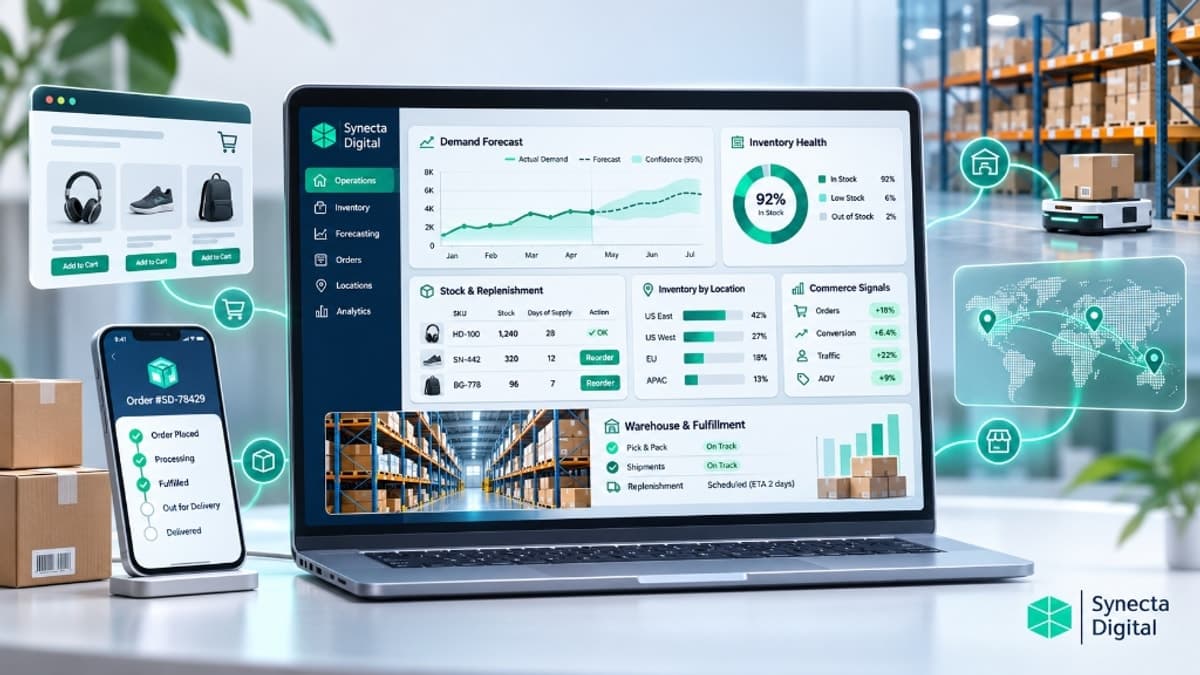
Some of the strongest operational returns from AI in eCommerce come from smarter inventory planning. Holding excess slow-moving stock locks up working capital, while stockouts on popular items waste marketing spend and send buyers to competitors.
It is important to distinguish basic inventory synchronization from predictive analytics. Basic synchronization records transactions in real time—deducting a unit when an item sells on Shopify POS or WooCommerce. Predictive analytics evaluates historical velocity, supplier lead times, and seasonal trends to forecast what will happen next.
Basic Inventory Synchronization vs. AI Predictive Analytics
Why growing multi-channel retailers pair real-time stock sync with predictive demand modeling.
Basic Inventory Synchronization
Essential for day-to-day stock accuracy across channels
- Deducts stock counts immediately when an item sells online or at a POS counter
- Shows current on-hand quantities across warehouse and store locations
- Triggers static low-stock alerts only after inventory drops below a fixed number
- Does not account for upcoming seasonal spikes or supplier lead-time changes
AI Predictive Inventory Analytics
Optimizes purchasing, cash flow, and multi-location allocation
- Demand forecasting: Calculates SKU-level reorder points from sales velocity and supplier lead times
- Seasonal demand predictions: Anticipates holiday, promotional, and weather-driven demand weeks ahead
- Multi-location optimization: Recommends stock transfers between branches and warehouses to prevent stockouts
- Smarter purchasing decisions: Flags slow-moving SKUs early so teams can protect working capital
Predictive models work best when eCommerce storefronts, inventory and warehousing management, POS registers, and ERP or accounting tools—such as a Shopify and QuickBooks integration—share clean, unified data.
AI in eCommerce Marketing and Content Creation
Scaling a large catalog and multi-channel marketing calendar requires continuous content production and data analysis. eCommerce automation powered by AI helps marketing teams execute faster and personalize customer outreach:
- Automated product descriptions: Converting raw supplier specifications into structured product copy, bullet highlights, and catalog tags.
- Customer segmentation: Grouping audiences by Recency, Frequency, and Monetary (RFM) value, category affinity, and churn probability.
- Email personalization: Customizing product blocks, send times, and win-back flows to individual buying cycles.
- Advertising optimization and campaign analysis: Testing creative variations and analyzing cross-channel attribution.
- SEO assistance: Clustering keyword topics, drafting metadata, and structuring FAQ schema alongside professional SEO and search optimization services.
Why Human Oversight Remains Essential in AI Marketing
Despite these efficiencies, human oversight remains essential. Publishing unedited AI copy across a store can introduce technical errors in product specifications, repetitive phrasing, and an impersonal tone. Effective teams use AI for initial drafts and data segmentation while human editors verify accuracy, originality, and brand consistency.
AI in Payment Security and Fraud Detection
Online checkout must remain frictionless for genuine buyers while stopping fraudulent transactions and chargebacks. Traditional fraud filters that rely on rigid static rules—such as blocking every order where billing and shipping countries differ—frequently trigger false positives, declining legitimate international shoppers or repeat customers.
AI-Assisted Transaction Monitoring
Evaluates dozens of risk signals in milliseconds, including IP geolocation, device fingerprinting, card network history, and checkout behavior.
Suspicious Behavior Detection
Stops automated card-testing bots, account takeovers, and abnormal bulk orders before payment processing fees and chargebacks accumulate.
Reducing False Positives
Allows legitimate cross-border and high-value orders to pass smoothly while applying step-up verification (such as 3D Secure) only when genuine risk anomalies appear.
Combining machine learning fraud scoring with properly engineered payment gateway and checkout integrations protects merchant revenue without sacrificing checkout conversion.
Agentic Commerce — The Next Evolution of Online Shopping
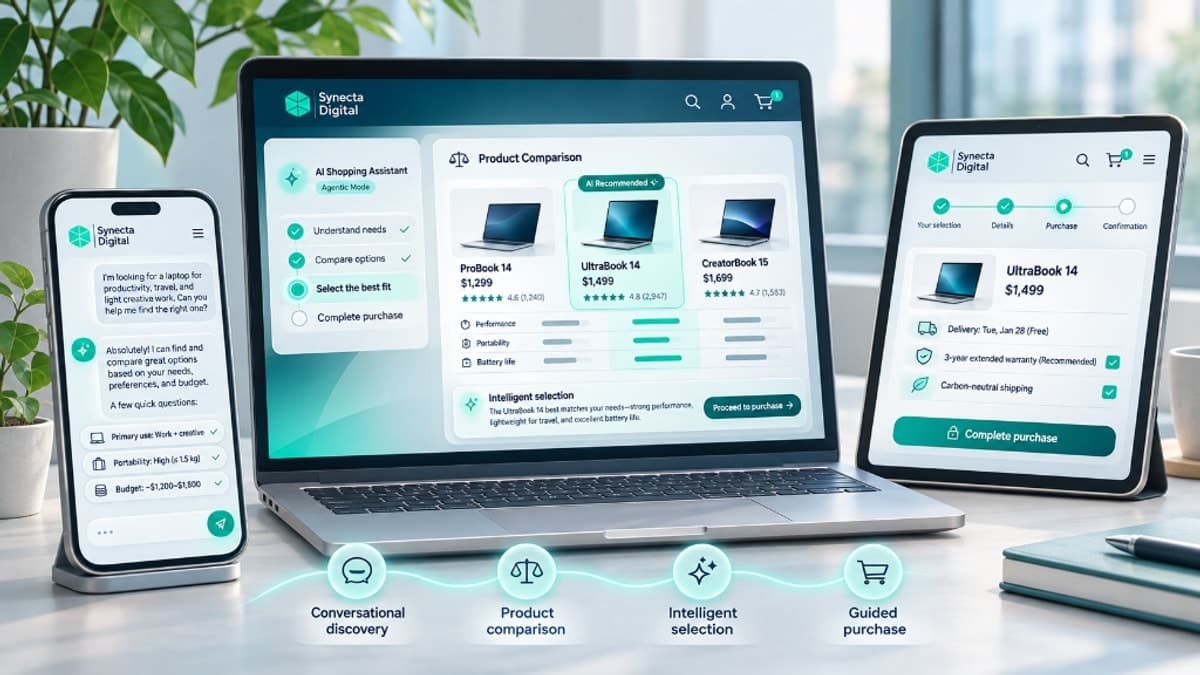
A major shift emerging in digital retail is agentic commerce—shopping experiences in which AI agents help consumers research, compare, evaluate, and increasingly initiate purchases across online stores.
Instead of manually browsing dozens of tabs, shoppers increasingly ask conversational AI assistants to find and compare products that meet specific criteria—such as comparing ergonomic office chairs under a set budget with lumbar adjustment and local warranty coverage.
- AI shopping agents: Software assistants that interpret multi-constraint buyer requests and gather matching options across merchant catalogs.
- Conversational product discovery and comparisons: Evaluating technical specifications, pricing, verified reviews, shipping timelines, and return policies side by side.
- AI-enabled purchasing workflows: Emerging integrations that guide buyers from an AI research conversation directly into merchant checkout flows.
- Product data accuracy: Because AI agents parse structured feeds and schema markup rather than visual design alone, accurate SKU attributes, live stock counts, and clear policy data are vital.
Major platforms have already launched foundational capabilities in this area. Google connects its Shopping Graph with AI-assisted Search and Gemini to surface live merchant listings; OpenAI and Perplexity provide conversational shopping discovery and catalog integrations; and Shopify offers AI commerce tools—including Shopify Magic, Sidekick, and standardized catalog APIs—to help merchants structure product data.
Agentic Commerce Maturity: What Is Live vs. What Is Emerging
Separating practical capabilities merchants can optimize for today from developing industry standards.
Conversational Discovery & Guided Shopping
Capabilities retailers should optimize for immediately
- Conversational product discovery across AI search engines and shopping assistants
- AI-assisted side-by-side specification, price, and review comparisons
- On-site virtual shopping assistants connected to live store catalogs and policies
- Structured product feed indexing via Schema.org JSON-LD and merchant center APIs
Autonomous Multi-Merchant Checkout
Developing standards across payment networks and platforms
- Fully autonomous end-to-end purchasing without human checkout confirmation
- External AI agents independently authorizing payment tokens across arbitrary stores
- Universal cross-platform agent identity, liability, and authentication protocols
- Automated post-purchase dispute or return negotiation between consumer and merchant agents
Retailers should clearly distinguish widely available functionality from emerging capabilities. Optimizing product catalogs via Generative Engine Optimization (GEO) helps brands stay visible across AI-driven discovery channels today while preparing their data architecture for future agentic workflows.
Challenges and Risks of AI Adoption
While AI delivers strong operational benefits, adopting it without governance introduces real risks. AI is not a solution to every business problem—it cannot fix poor product quality, slow fulfillment, broken checkout flows, or disorganized operations.
Customer Data Privacy
Personalization and analytics tools must comply with GDPR, CCPA, and national data protection laws, respecting customer consent and data minimization.
Data Security
Connecting third-party AI tools to customer records or ERP systems requires strict API scoping, encryption, and careful vendor vetting.
Incorrect AI-Generated Information
Unguarded generative models can invent product specifications, misquote prices, or state inaccurate shipping and return policies.
Algorithmic Bias
Poorly calibrated models can skew product recommendations or unfairly flag legitimate international orders from specific regions.
Implementation Costs
Stacking overlapping AI subscriptions increases monthly overhead and can slow storefront page speed if scripts are poorly integrated.
Integration Complexity
Disconnected legacy POS or spreadsheet inventory systems will cause customer-facing AI tools to surface inaccurate stock answers.
Customer Trust and Human Oversight
Buyers expect transparency when interacting with AI and straightforward access to human support when issues require empathy or judgment.
How Businesses Can Prepare for AI-Driven Commerce
Preparing for AI-powered retail starts with strong commerce fundamentals rather than chasing every new tool. Follow this seven-step implementation roadmap:
1. Build a Strong Digital Commerce Foundation
Operate on a fast, mobile-first storefront architecture—whether on Shopify, WooCommerce, or a custom web platform built through professional eCommerce storefront and commerce development.
2. Maintain Accurate Product and Customer Data
Standardize SKU titles, variant attributes (size, material, compatibility), pricing, and inventory records so AI search and recommendation tools have clean data to reference.
3. Identify Suitable Opportunities for Automation
Audit where your operation experiences real friction—such as repetitive support tickets, failed site searches, or manual accounting reconciliation—before selecting tools.
4. Introduce Practical AI Tools
Begin with proven, high-impact capabilities like semantic site search, personalized product recommendations, or a grounded support assistant with clear human escalation thresholds.
5. Integrate Business Systems
Connect your online store, physical POS, inventory, and accounting systems through commerce automation and system integrations. Unifying online and retail inventory—as detailed in our Shopify POS Complete Guide—ensures AI tools work with accurate real-time stock.
6. Prepare Product Information for AI-Powered Discovery
Deploy Schema.org JSON-LD markup, maintain clean Google Merchant Center feeds, and publish transparent shipping and return policies. This is particularly helpful for brands selling internationally from Sri Lanka and competing in global markets.
7. Measure Results and Continuously Optimize
Monitor conversion rates, average order value, support resolution accuracy, and page speed through reliable digital marketing and analytics setup, refining tools based on measurable ROI.
The Future of AI in eCommerce
The future of eCommerce will be shaped by how naturally intelligence connects customer experiences with backend operations:
6 Key Developments Shaping the Future of AI-Powered Retail
AI Shopping Agents & Conversational Commerce
Guided dialogue will work alongside traditional category browsing to help shoppers compare and select complex products.
Intelligent Product Discovery
Multimodal search combining text, voice, and visual imagery will make large catalogs effortless to navigate.
Hyper-Personalization
Storefronts and lifecycle messaging will adapt to real-time buyer context while respecting customer privacy.
Automated Business Processes
Catalog tagging, supplier reorder drafting, financial reconciliation, and support triage will require far less manual effort.
AI-Powered Business Insights
Decision-makers will receive clear diagnostic summaries on margins, return drivers, and demand shifts.
Unified Digital Commerce Experiences
Online storefronts, mobile apps, social channels, and physical retail counters will operate from one connected intelligence layer.
Frequently Asked Questions
How is artificial intelligence used in eCommerce?
Artificial intelligence is used in eCommerce to power personalized product recommendations, semantic and visual site search, 24/7 virtual shopping assistants, predictive inventory forecasting, marketing and catalog automation, and real-time payment fraud detection.
What are the benefits of AI for online retailers?
AI helps online retailers improve product discovery and conversion rates, increase average order value through relevant cross-selling, reduce repetitive customer support tickets, prevent stockouts or overstocking, and lower false payment declines at checkout.
Can small businesses use AI in eCommerce?
Yes. Small and mid-sized retailers do not need custom proprietary models. Platforms such as Shopify in Sri Lanka and worldwide, WooCommerce, and modern API integrations provide accessible AI tools for search, recommendations, customer support, and marketing that scale with a business's budget.
Will AI replace traditional eCommerce websites?
No. While AI search and shopping assistants are growing discovery channels, your eCommerce website remains the central hub for brand trust, verified product data, live inventory, customer accounts, and secure checkout. AI enhances a well-built store rather than replacing it.
What is agentic commerce?
Agentic commerce refers to online shopping workflows where AI agents act on a shopper's behalf to research products, compare specifications and prices across merchants, check availability and shipping policies, and assist with purchasing tasks.
How can businesses get started with AI-powered eCommerce?
Businesses should start by ensuring their storefront is fast and mobile-friendly, organizing accurate product and inventory data, identifying clear operational bottlenecks, and integrating practical AI tools for search, support, or personalization that connect cleanly with existing systems.
Conclusion
Artificial intelligence is transforming online retail through smarter personalization, practical automation, responsive customer experiences, and data-backed inventory and operational decision-making. Across AI in online shopping, the businesses seeing lasting results are those treating AI not as a standalone shortcut, but as an extension of a well-engineered commerce operation.
Successful AI adoption depends on reliable digital infrastructure, accurate product and customer data, and well-integrated business systems. At Synecta Digital, we work with businesses in Sri Lanka and internationally to develop, integrate, and optimize modern digital commerce operations—spanning Shopify store development, WooCommerce and custom web platforms, eCommerce development services, retail POS and ERP integrations, and practical AI for eCommerce solutions.
Ready to Build Smarter, Connected eCommerce Operations?
Talk to Synecta Digital about developing, integrating, and optimizing your online store, retail systems, and practical AI capabilities around your business goals.
Have a commerce project in mind?
Tell us what you're building, improving, or trying to connect. Our eCommerce specialists will review your project and recommend the right implementation approach.